Constitution Revised November, 2009 (PDF download at bottom of page)
ARTICLE I NAME
SECTION 1- Name of this organization shall be the Michigan Art Education Association, a nonprofit corporation organized under the laws of the State of Michigan. It is recognized by the Internal Revenue Service as exempt under Section 501 (c) (3) on the Internal Revenue Code.
SECTION 2- The Michigan Art Education Association will be affiliated with National Art Education Association.
ARTICLE II PURPOSE
SECTION 1- The purpose of the Michigan Art Education Association is to organize, unify, and support Art Educators in the State of Michigan.
(a) To encourage and strengthen creative visual art curriculum aligned with MDE Standards and Benchmarks at all levels.
(b) To support and promote quality and training of future Art Educators.
(c) To identify and promote outstanding visual art programs
(d) To cooperate with appropriate arts agencies and organizations state wide.
(e) To officially represent the Michigan Art Education Association membership in an advisory capacity to the State Board of Education, State Legislature or any other appropriate bodies.
SECTION 2- Limitations
(a) Said organization is organized exclusively for charitable, religious, educational and scientific purposes, including for such purposes, the making of distributions to organizations that qualify as exempt organizations under section 501 (c) (3) of the Internal Revenue Code, or corresponding section of any future federal tax code.
(b) No part of the net earnings of the organization shall inure to the benefit of, or be distributable to its members, trustees, officers, or other private persons, except that the organization shall be authorized and empowered to pay reasonable compensation for services rendered either by contract or employment and to make payments and distributions in furtherance of the purposes set forth in the purpose clause hereof. No substantial part of the activities of the organization shall be the carried on of propaganda, or otherwise attempting to influence legislation, and the organization shall not participate in, or intervene in (including the publishing or distribution of statements) any political campaign on behalf of any candidate for public office. Notwithstanding any other provision of this document, the organization shall not carry on any other activities not permitted to be carried on (a) by an organization exempt from federal income under section 501 (c) (3) of the Internal Revenue Code, corresponding section of any future federal tax code, or (b) by an organization, contributions to which are deductible under section 170 (c) (2) of the Internal Revenue Code, or corresponding section of any future federal tax code.
(c) Upon the dissolution of the organization, assets shall be distributed for one or more exempt purposes within the meaning of section 501 (c) (3) of the Internal Revenue Code, or corresponding section of any future federal tax code, or to a state or local government, for a public purpose. Any such assets not disposed of shall be disposed of by the Court of Common Pleas of the county in which the principal office of the organization is then located, exclusively for such purposes or to such organization or organizations, as said court shall determine, which are organized and operated exclusively for such purposes.
ARTICLE III MEMBERSHIP
Any individual, institution or organization whose concerns are to foster visual art education in the State of Michigan shall be eligible for membership.
ARTICLE IV OFFICERS, LIAISONS, EXECUTIVE SECRETARY and STANDING COMMITTEES
SECTION 1- The elected officers of the Association are President, President-Elect, Vice President, Membership Secretary, Secretary, Treasurer, and NAEA Delegate. The elected officers shall serve a two-year term of office. These elected officers and the Past President shall comprise the Executive Board of the Michigan Art Education Association. Additionally the communications director and conference treasurer shall serve as ex-officio members.
SECTION 2- All officers will be members of the MAEA/NAEA.
SECTION 3- Standing Committee Chairpersons are appointed by the President. Chair recommendations may come from the Executive Board and the Council. The Chairs are voting members of the Council. Standing Committees are: Awards, Michigan Youth Arts Festival, Michigan Youth Arts Month, Finance, Summer Professional Development Opportunities, Conference Director(s), Historian, Communications, Art Acquisitions, Governor’s Traveling Show, Elementary & Middle Level Exhibit, Museum Division, Advocacy, Lifelong Learning, Multi-Ethnic, Council Leadership Development and Technology SECTION 4- Special Committees for specific purposes may be authorized by the council as occasion requires.
SECTION 5- A representative is appointed by the President with approval by the council to each of the recognized divisions and affiliates of the NAEA. Divisions are: Elementary Division, Middle Level Division, Secondary Division, Higher Education, Supervision and Administration, Museum Education.
SECTION 6- Liaisons will represent the MAEA State Regions, Retired Michigan Art Educators, and Student Members on the Council.
SECTION 7- In the event of affiliations with other organizations, a liaison to represent MAEA will be appointed by the Executive Council.
SECTION 8- The delegate(s) to the National Art Education Association are comprised of the President in second year of office and first year as Past President and an elected delegate from the membership effective as of 2007
SECTION 9- The duties of the elected officers, appointed chairs, standing committee, Executive Secretary and the Region Liaisons are listed in the By-laws.
SECTION 10- By a majority vote of the MAEA council, the position of Executive Secretary (or another title designated by the president) may be initiated or terminated. The position of Executive Secretary will administer to the policies and the infrastructure of the association in accordance with the MAEA mission under the supervision of the president. The duties of the Executive Secretary are listed in the By-laws.
SECTION 11- MAEA Council may designate other paid positions as deemed necessary.
ARTICLE V THE COUNCIL
SECTION 1- A general meeting of the Association is held each year in conjunction with the annual fall conference. Special general meetings may be called by action of the Council; and/or written requests by twenty-five percent of the membership.
SECTION 2- In addition to one general meeting yearly, a minimum of four Council meetings will be held.
SECTION 3- The method of procedure at all meetings will be governed by Robert’s Rules of Order - latest revision.
SECTION 4- Procedures for meeting:
Call to order by the President
Communiqués
Additions to the agenda
Officer’s Reports
Minutes
Treasurer
Vice President
Membership Secretary
NAEA Delegate (s)
Selected Officer, Committee and Service Reports
Council Session
Council Planning Session
New/ Old business
Adjournment
ARTICLE VI QUORUM
SECTION 1- Twenty-five percent of the membership will constitute a quorum at any regularly called general meeting of the Association.
SECTION 2- Twenty-five percent of the Council will constitute a quorum.
SECTION 3- Four members of the eight member Executive Board will constitute a quorum.
SECTION 4- Association business may be decided by a simple majority vote of the returned printed ballots by the total membership.
ARTICLE VII AMENDMENTS TO CONSTITUTION AND BY-LAWS
SECTION 1- The Constitution may be altered or amended by two-thirds of the returned printed ballots by the membership.
SECTION 2- By-law adoption can be implemented by a simple majority vote of printed ballots returned by the membership.
ARTICLE VIII [Fiscal Year]
The fiscal year of the MAEA will begin on the first calendar day of January and end on the last day of December of each calendar year.
Submitted by Conference Revision Committee [Madeline Milidonis-Fritz, Mary Miller, Pam TerBush, Dennis Inhulsen, Ron Frenzen ,Rich Guimond]
Revised November 2005
By-laws
Revised November 2005
I. DUTIES OF THE MAEA OFFICERS, APPOINTED CHAIRS AND LIAISONS
SECTION 1 PRESIDENT
(a) To preside at all executive and council meetings of the MAEA and set agenda.
(b) To supervise the officers in an effort to insure excellence in performance of assignments.
(c) To review, maintain, and execute Association policy and correspondence.
(d) To appoint an interim officer with Council approval, in the event of an Executive vacancy.
(e) To appoint Standing Committee Chairpersons with concurrence of a simple majority vote of the council.
(f) To appoint appropriate Ex-Officio members to the Council concurrent with the President’s term of office. Ex-Officio members are non voting members.
(g) To serve as Ex-Officio member of all committees and to represent MAEA/NAEA whenever appropriate unless he/she appoints someone in his/her place.
(h) To function as a Delegate to NAEA State’s Assembly during second year of office.
(i) To oversee budget planning at December Executive Council meeting.
(j) To facilitate the revision and implementation of the strategic plan.
(k) To set the calendar in cooperation with Division Chairs for distribution at annual conference.
(l) To approve financial expenditures and forward to the bookkeeper for payment.
SECTION 2 PRESIDENT-ELECT
(a) To assume the duties of the President in case that officer is unable to serve.
(b) To work with the president on the bi-annual revision and implementation of the strategic plan.
(c) To ensure the Council is functioning within the framework of the current Constitution and that the Constitution and By-laws are updated to meet the needs of MAEA.
(d) To be Ex-Officio member of all standing committees.
(e) To facilitate recommended changes in the constitution or By-laws
(f) To organize and arrange for executive and council meeting facilities as well as amenities as needed.
SECTION 3 PAST PRESIDENT
(a) To act as advisor to the President and council.
(b) To serve as delegate to the NAEA delegates assembly.
(c) To serve as Ex-Officio member for all committees.
(d) To serve as chair of the nominating committee and elections.
SECTION 4 VICE PRESIDENT
(a) To assume the duties of President-Elect if that Officer is unable to serve.
(b) To maintain communication with Region Liaison Officers.
(c) To develop a communication network with the Region Liaison officers:
(1) To disseminate pertinent information about the State of the Arts to the Region Liaison Officers
(2) To disseminate pertinent information about MAEA Activities to the region Liaisons.
(d) To maintain and update the “Regional Liaison Handbook”.
(e) To develop and facilitate a Region Liaison workshop at the leadership retreat.
SECTION 5 MEMBERSHIP SECRETARY
(a) To maintain a current listing of membership and status of the Association.
(b) To develop, maintain, and update the membership packet.
(c) To establish strategies for membership drives.
(d) To facilitate the annual publication of a membership directory.
(e) To maintain, update and publish the MAEA Council
directory.
(f) To provide mailing labels as needed by council.
(g) To facilitate communication through mass email to
members with executive council approval.
SECTION 6 SECRETARY
(a) To record minutes of the Association meetings, Council meetings and Executive Board meetings.
(b) To make copies of minutes available to all members of the Council and include them in the Secretary’s file.
(c) To assist the President in developing the agendas.
(d) To assist the President with Association correspondence.
(e) To maintain the “MAEA Policy Handbook”.
SECTION 7 TREASURER AND MAEA FINANCES
(a) To handle all expenditures concerning MAEA funds in collaboration with accounting professionals.
(b) To oversee/facilitate long range financial planning in conjunction with approved professional(s) recommended by the committee.
(c) To submit an annual operating budget to the Executive Board and Council at the January meeting for approval.
(d) To submit records for financial review:
(1) Written report to be published for the General
Business Meeting
(2) To submit an in house financial review during
off election years.
(3) To submit a written independent financial
review [audit] following a general election.
(e) Routine expenditures within the budgetary allowances authorized by the Council may be approved by the officer involved.
(f) To maintain 501 C3 and report status annually at executive board summer budget meeting.
(g) Expenditures within the budget shall not exceed the assets of the organization.
SECTION 8 BOOK KEEPER
(1) All financial reports shall be submitted within
generally accepted accounting formats.
(2) To prepare an updated line-item budget prior to
each executive council meeting. The budget will be based on a [the fiscal year stated in the constitution] fiscal year beginning January 1 and ending December 31.
(3) To prepare the written report for presentation
at the executive, council meetings and annual business meeting.
(4) To prepare the books for the annual review by
the accountants and for income tax preparation.
(5) To co-sign accounts that control operating account and conference accounts.
(6) The Treasurer and bookkeeper shall be bonded.
(7) On any given line item, additional funds may be
transferred by approval of the Council and
notification of parties.
(8) All Standing Committees that control funds shall have accounts co-signed and supervised by the President and Treasurer.
SECTION 9 DELEGATES TO STATE’S ASSEMBLY
(a) To conduct states assembly business as directed by the MAEA and outlined in the NAEA.
(b) To represent MAEA positions to the NAEA.
(c) To establish a communication between MAEA/NAEA.
(d) To submit written reports for the MAEA Annual Business Report presented at the Fall Conference.
(e) To submit a written Delegate Assembly report for publication to the membership.
SECTION 10 REGION LIAISON OFFICERS
(a) To be elected or appointed at the region level. If there is no active region organization, a volunteer may be approved by the Executive Board and the Council.
(b) To be presented by the Vice President to the Council for appointment.
(c) To serve a minimum of two years concurrent with the school year. Any change over is to take place at the annual leadership retreat.
(d) To be active voting members of the Council and attend all council meetings or send an alternate.
(e) To be responsible for disseminating all MAEA information to their region membership.
(f) To help to carry on the business of the Association by active participation in Council meetings and by serving on Council committees.
(g) To actively assist in membership enlistment and Public Relations. The procedures for these are to be outlined in the Liaison Handbook, with direction from the Membership Secretary.
(h) To submit an annual report on the state of their region to the Vice President at the leadership retreat.
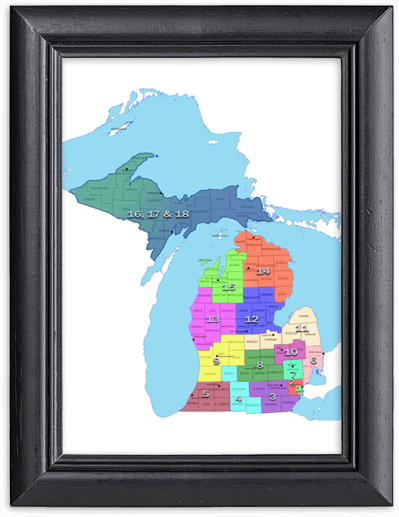
(i) Regional representation will be based on geographic divisions of membership by counties within the State of Michigan.
SECTION 11 CONFERENCE DIRECTOR(S)
(a) To assume responsibilities of all aspects of the planning and execution of the Association’s Annual Conference in coordination with the Executive Board and the Council.
(b) To be responsible for holding the monies associated with the Fall conference in a co-signature account with the treasurer and bookkeeper.
(c) To submit a year-end report at the January meeting following the conference and a final written financial report, containing all expenditures and receipts related to the conference, subject to financial review, by the March Council Meeting following their conference.
(d) To maintain and update the MAEA Conference Procedure Handbook and return it to the President after their conference.
(e) To maintain the conference file of all programs, financial records and submit them to the Historian.
SECTION 12 ELEMENTARY, MIDDLE, SECONDARY, AND HIGHER EDUCATIONAL DIVISIONAL CHAIRPERSONS
(a) To conduct states assembly business as directed by the MAEA and outlined by the NAEA.
SECTION 13 HISTORIAN
(a) To maintain and update the historical archives of the MAEA.
(b) To supervise and maintain current and past MAEA properties.
(c) To act as a resource to the Council.
(d) To be responsible for written annual summary of MAEA activities.
(e) To supervise the lending and recovery of MAEA/NAEA properties.
SECTION 14 COMMUNICATIONS DIRECTOR
(a) To be appointed by the President with approval of the Council and be responsible for all matters of editorial policy, content and publication cost.
(b) Develop and implement, in conjunction with the designated printers, Editor(s) and the Production Chair the production schedule for MAEA publications.
(c) Develop and implement the strategy for e- communications. Maintain e-communication database to ensure privacy is maintained. Work to collect and use new email addresses
(d) Work closely with the Executive Board and Council Members to acquire and position all related copy into the necessary MAEA publications, according to the production schedule. Effectively proof all copy for the publication.
(e) Manage the production schedules for all printed publications maintaining positive working relationships with current and potential printers.
(f) Oversee the Maintenance of the MAEA’s website, including the updating of all required information, revising text and adding new sections – as requested by the President and Technology Chair.
(g) Oversee the MAEA Editor(s), Web Designer and Publications Chair to maintain and improve communications between MAEA members and leadership.
(h) Advise conference chairs on most efficient website and publications strategy for effective conference communications.
(i) See council approved job descriptions for communications positions
(1) EDITOR
Report to the Communications Director, the Editor is responsible for the factual and grammatical accuracy and professional appearance of all MAEA publications.
(2) WEBMASTER
Report to the Communications Director, the web designer is responsible for maintaining the MAEA’s website and assisting with e-communication efforts.
SECTION 15 STANDING COMMITTEES
(a) To be appointed by the President with approval from the Council. Chair recommendations may come from the Executive Board and the Council. The Chairs are voting members of the Council. Standing Committees are: Awards, Michigan Youth Arts Festival, Michigan Youth Arts Month, Finance, Summer Professional Development Opportunities, Conference Director(s), Historian, Communications, Art Acquisitions, (Governor’s) Traveling Show, Elementary & Middle Level Exhibit, Museum Division, Advocacy, Lifelong Learning, Multi-Ethnic, and Technology.
(b) Standing committee chairs will serve a term of office which will run concurrent with the President’s term of office.
(c) The Nominating Committee shall be established at the March Council meeting of an election year.
SECTION 16 EXECUTIVE SECRETARY
(a) An ad hoc committee appointed by the president will be charged to: establish and maintain the general job description, duties, salary and employment hours of the Executive Secretary. This committee also will monitor and annually review this position with recommendations on job performance and future concerns to the president. The charges of this ad hoc committee will run concurrently with the president’s term of office.
(b) The Executive Secretary will serve on the MAEA Executive Board as a non-voting member.
(c) The MAEA president retains the sole authority to hire and dismiss the Executive Secretary based on the recommendations of the ad hoc committee whose responsibility is to monitor and review the performance of the Executive Secretary.
II. TERM OF OFFICE AND ELECTIONS
TERM OF OFFICE
SECTION 1- Elected Officers term of office will be for 2 years.
SECTION 2- The officers to be elected by a will be elected through the use of an electronic online ballot. Members without computer access may request that a hard copy of the ballot be mailed.
SECTION 3- Officers may not serve more than two consecutive terms of office, except for the Treasurer and Membership Secretary.
SECTION 4- A member may hold only one elected position concurrently.
SECTION 5- In the event of an Executive vacancy, the President will appoint an interim officer with approval of the Council.
ELECTIONS
SECTION 1- The Nominating Committee will consist of the Past President and 2 members elected by the Council.
SECTION 2- The nominating committee will bring nominations to the floor during the General Business Meeting at the Fall State Conference. Further nominations may be made from the floor at the time of the presentation of the slate. The election of the slate of officers shall take place immediately following the Fall State Conference by an online ballot The Nominating Committee is responsible for:
(a) Seeking and retaining appropriate
candidates for office through, but not limited to, a nominations form available to the entire membership. Nomination forms will be available on-line and in hard copy in a publication prior to the annual fall conference.
(b) Preparing the ballot.
(c) Verifying the ballot.
SECTION 3- Simple Majority of the returned submitted electronic and hard copy ballots by general membership shall determine election results.
[a] The ballot shall be posted on the MAEA website.
[b] Members without computer access may request a paper ballot in writing
[c] All members will be able to cast their ballot signing in with their NAEA/MAEA membership number.
[d] Each member will cast a vote that will be automatically counted separate from his/ her membership number thereby maintaining a secret ballot.
[e] Members will be able to submit write in candidates.
[f] Access to this election site will be restricted to the Chairperson and committee members only.
[g] The committee will verify the computer tally and a printout presented of this verification at the January Executive and Council meetings.
SECTION 4- In the event of a tie vote, the MAEA Council in secret ballot will determine the election.
SECTION 5- In the event that a tie still exists, the President will cast the deciding vote.
III. MEMBERSHIP
SECTION 1- Expression of interest in membership in the Michigan Art Education Association on the part of an individual, institution or organization is received by the Membership Secretary. Members may be classified into the following categories:
(a) Individual - any individual interested in visual art education in the State of Michigan.
(b) Organization - any formally constituted organization interested in or involved in art education.
(c) Institution - any institution interested in or involved in visual art education.
(d) Retired Art Educators - Retired Michigan Art Educators interested or involved in visual art education.
(e) Student – College students pursuing visual art education classes and desire to become a member.
(f) Sponsor - individuals, institutions or organizations who wish to financially support the Michigan Art Education Association.
(g) Honorary - individuals, institutions or organizations who in the opinion of the membership have made contributions to the arts or art education in Michigan.
SECTION 2- Membership to MAEA may be obtained by agreeing to the following stipulations:
(a) Abide by the rules of the Michigan Art Education Association and upon payment of appropriate dues per membership categories.
(b) Members will be obligated to pay dues annually, in advance.
(c) Changes in dues will be determined by the Council and approved by the membership.
SECTION 3- Membership privileges comprise:
(a) Each category described in SECTION 1 is entitled to one membership vote
(b) Each category is entitled to send one delegate to an MAEA Conference.
(c) Each category paid membership is entitled to submit artwork for exhibition as prescribed by the rules of the exhibit.
IV. STRATEGIC PLAN
SECTION 1-, The executive council will revisit the strategic plan process every four to five years with council advisement.
(a) To be facilitated cooperatively by the President and President-Elect.
[b] Assessment should be completed by council to determine the need for an outside facilitator.
November 2005 Revision
Submitted by Conference Revision Committee [ Madeline Milidonis-Fritz, Mary Miller, Pam TerBush, Dennis Inhulsen, Ron Frenzen, Rich Guimond]
Revised 2009: Executive Board and Council